#59 w-report WILD DINING
Chefs who play with Fire

FOR TWENTY YEARS, I’VE HAD THE PRIVILEGE TO DINE at dozens of singular restaurants, from Copenhagen to Sydney. I have covered all the restaurant trends, from molecular cuisine to zero-waste vegan kitchens. I’ve road tripped with celebrity chef Jose Andres through the north of Spain and pilgrimaged to remote Buddhist temples in Korea with David Chang to taste vegetarian temple food so flavorful that he begged the nuns for their secret recipes.
Many of those meals were outstanding and memorable, but the restaurants that still stand out sharply in my mind are the ones without stars (the Michelin kind anyway), without tablecloths, in some cases even without walls or a conventional professional kitchen. Almost always, there is fire.
THERE’S SOMETHING VERY PRIMAL ABOUT GATHERING AROUND FLAMES. EATING AROUND IT, WITH THE RIGHT CHEF, CAN BE REVOLUTIONARY.
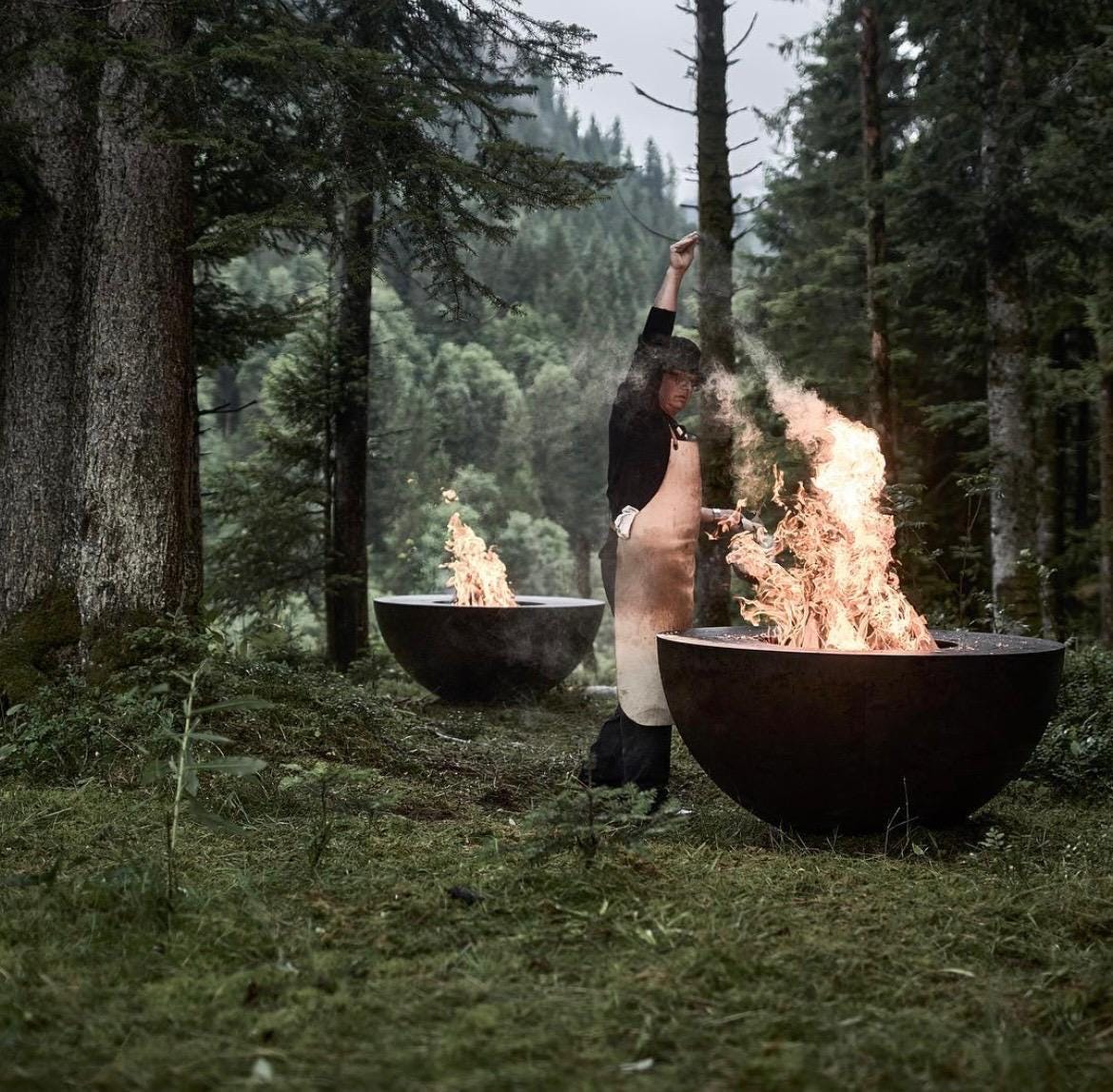
A few examples of those meals I won’t forget: a multi-course dinner cooked over various fires, which began with a ride on a vintage boat, which transported guests to the Lighthouse Island or Vuurtoreneiland restaurant, located on a tiny windswept island about a 40-minute boat ride from central Amsterdam in the middle of the Ijsselmeer. A few meals—one in the woods, another in the urban herb garden of Martin Rötzel in Berlin—cooked on a beautiful Feuerring (fire ring) by Mischa-Amadeus Olma, who then introduced me to the shaman/chef Stefan Wiesner in Switzerland where I then had another magical open air culinary experience. More recently, in Berlin, my favorite restaurants both cook with fire: Kramer and Stoke, which I just did a story about for Freunden von Freunden.
BUT THE GREATEST OF THEM ALL WAS A PILGRIMAGE I TOOK A FEW YEARS AGO TO LA ISLA, FRANCIS MALLMANN’S ISLAND IN PATAGONIA.
Twenty years ago, when the molecular culinary movement, innovated by the legendary Spanish chef Ferran Adria, was peaking, Mallmann stopped using tweezers, stepped away from the Michelin star path and came out with a book called Seven Fires.
More recently, Mallmann started to allow the occasional group to experience La Isla, his private island on Lago de Plata in remote Patagonia. He discovered the lake and the island with a friend in the late 80s and over the years built a charming log cabin in a small cove surrounded by crooked, weathered trees. About a decade ago he, along with his brother Carlos, a contractor, started building some additional cabins on the other side of the island. It’s now a stunning complex of three low-slung buildings designed with facades of black corrugated metal and large glass windows, from a distance, disappear seamlessly into the landscape, but up close, have a surprisingly modern aesthetic.


The journey here requires a flight to the hard-scrabble city of Comodoro, then a six hour drive along a lonely road through dramatic arid landscapes and big Patagonian skies that might involve fording a small river, and finally a 40-minute boat ride, which can be so bitterly cold, even in the summer, that you have to zip yourself into a puffy mono-suit and Swedish fisherman overalls.
“A lot of people won’t come because I didn’t build a helipad,” Mallmann told me. “I asked around and environmentalists told me that the birds and animals will absolutely hate the noise, so I made the decision to not allow it. One of the true luxuries of La Isla is the silence.” The arduous, long voyage I made to Mallmann’s refuge was rewarded almost immediately with an overwhelming sense of relief upon FINALLY arriving, but also by the haunting natural beauty of its setting: a forested island of slate grey coihue trees crooked and naked from the harsh wind, some branches draped with wisps of yellow green bearded lichen.
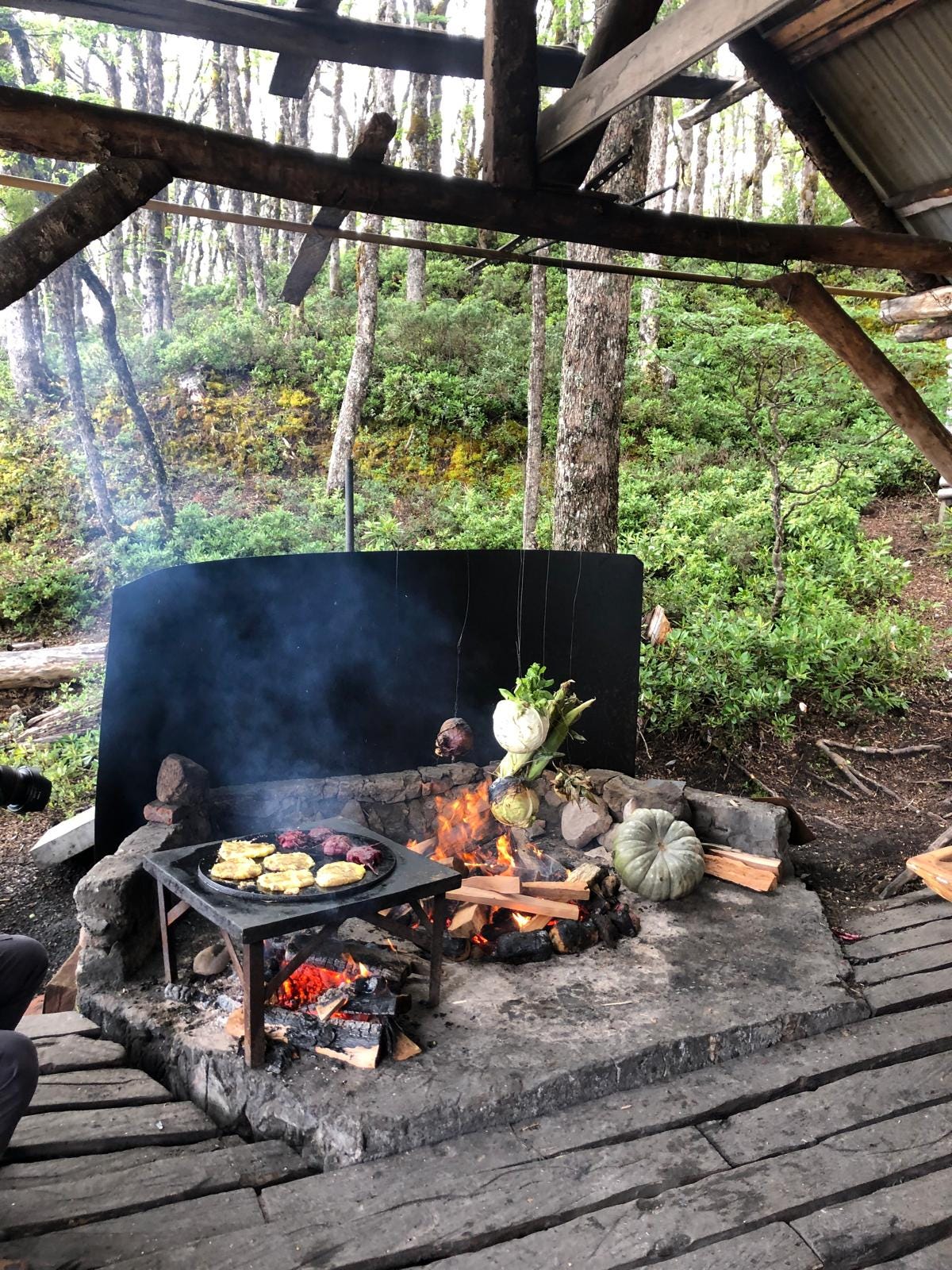
And then there is the food. Guests at La Isla have the luxury of Mallmann himself preparing several of their meals, teaching them about the techniques and poetry of cooking over fire. On the first day he often likes to sit around the fire for its entire life cycle with his guests, from first spark to dark red coals and ash. “It’s an age-old ritual and there’s something deeply meditative about staring into the flames,” he described. “It slows you down. Sitting around and cooking with fire has to do with a fascination with the collective human memory and the communal.”
The lunch I will never forget took six hours to prepare. Pineapples and cabbages were hooked on metal wires that dangled over the fire and then slowly cooked for hours, eventually becoming creamy soft and smoky; beets were baked in coals and then smashed on a massive griddle and drowned in olive oil and vinegar and eventually served in the most delicious salad with goat cheese and thin slivers of toasted almonds; and tomatoes and eggplants were sliced almost as thin as paper, stacked together, slowly cooked on the griddle, lashed with olive oil and sea salt and then served with a flurry of lemon zest as a refined, charcoaled ratatouille. If someone asked me what I’d like for my last meal, this is the one I would want to eat again.